
Would you trust an AI model with US$2 million?
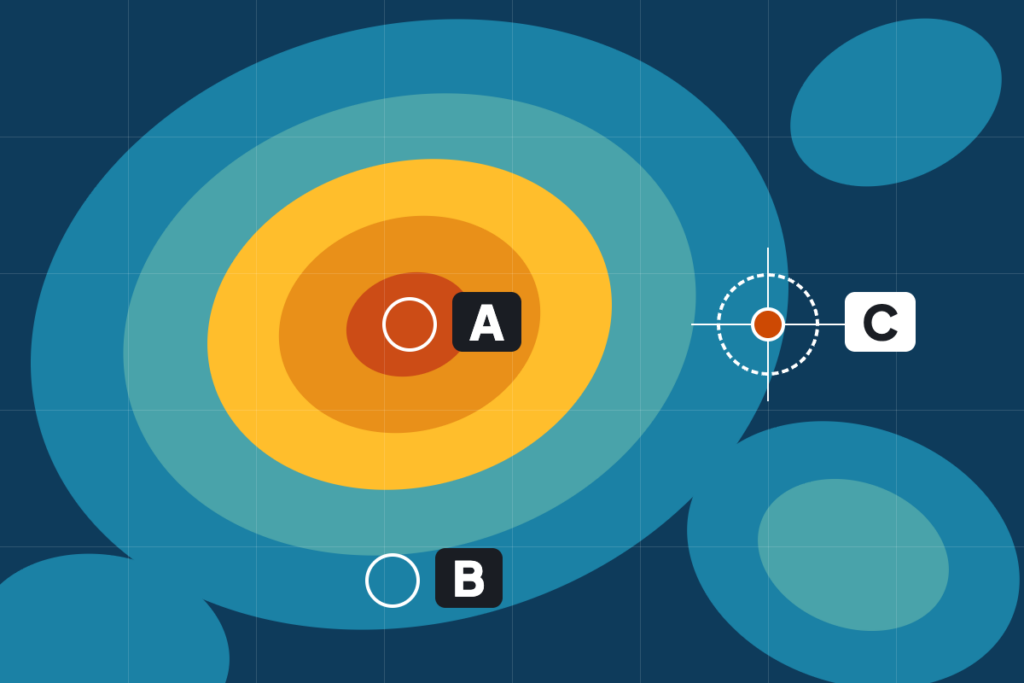


Imagine you’re an exploration manager at a mining company. You have US$2 million for a drilling campaign, and an artificial intelligence model recommends drilling where your team never would have. Do you approve it?
I recently put this question to an Introduction to Mining class. This is what I showed them, and why I think the right question isn’t whether the model gets it right, but whether it can explain why.
What was at the surface, we’ve already found
The world needs more and more copper and is finding less and less. According to an S&P Global study published this year(opens in a new tab), demand will grow 50% by 2040, to 42 million tonnes a year, while production will peak in 2030 at 33 million. The result is a 10-million-tonne deficit: 25% of demand left unmet.
In 1997 there were 20 major copper discoveries, with an exploration budget of US$758 million. In 2024 there was only one(opens in a new tab), with US$3.2 billion: four times the budget for one-twentieth of the discoveries. And finding a deposit isn’t enough. Fewer than 1 in 10,000 exploration projects becomes a mine(opens in a new tab), and it now takes an average of 17.8 years to go from discovery to production, almost triple the time in the 1990s(opens in a new tab). A deposit discovered this year won’t produce copper before 2044.
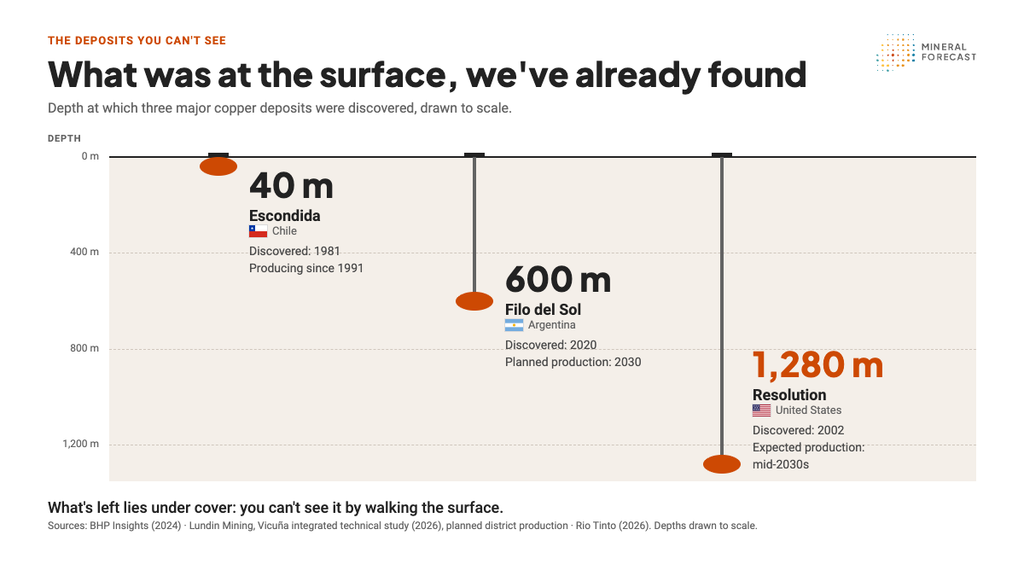
The reason is simple: what was at the surface, we’ve already found. Escondida was discovered in 1981 at a depth of 40 meters. Filo del Sol was found in 2020 at 600 meters, and Resolution in 2002 at 1,280 meters, according to BHP’s review of major copper discoveries since 1900(opens in a new tab). What’s left lies under cover, and you can’t see it by walking the surface.
I came to mining in 2024, after years of building software for the financial industry and fintechs. Same craft, opposite problem: I went from having plenty of structured, usable data to mineral exploration, where data is always scarce. An exploration project may have only 30 drill holes, each costing between US$50,000 and US$200,000. From those few dozen points, you have to infer what lies beneath thousands of hectares.
You don’t invent the light bulb by improving candles. More drill holes or more detailed maps are better candles. To search where you can’t see, we need new tools.
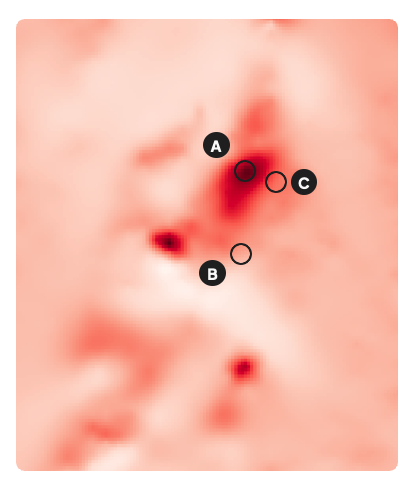
Where would you drill: A, B or C?
In class, we did an exercise with a real case. First we showed only a magnetometry map, with three possible zones: A, over the magnetic high; B, to the south; and C, to the east. It was an iron deposit, and because magnetite is magnetic, the most intuitive choice was the reddest spot: A.
But geology is rarely explained by a single variable.
Then we added five layers of information over the same three zones: lithology, alteration, structures, gravimetry and local magnetometry. A geologist can integrate all of this information, but doing it simultaneously at this scale is hard. A person can relate about four variables at once(opens in a new tab).
The model determined that the most mineralized zone wasn’t A, over the magnetic high, but C, to the east. To get there, it analyzed 112 variables and identified the relationships between them. It also helped find zones that hadn’t been identified before, and when they were drilled, the mineralization in the drill core matched what the model had predicted.
If a model can’t explain why, no one uses it
The lesson of the exercise is that the pattern lies in the combination of layers. High magnetometry alone pointed to A. Combined with lithology, alteration and structures, it pointed east. The model doesn’t look for the most magnetic point: it looks for that combination of layers, through non-linear relationships that we, as humans, can’t see.
But if the pattern can’t be seen with the naked eye, no one approves a US$2 million campaign because a model said so. Without an explanation, a hit looks like luck, and luck doesn’t repeat. That’s why at Mineral Forecast we built explainable AI (XAI): the ability to answer why this point and not the one next to it, variable by variable.
It isn’t ChatGPT either. There is no internet corpus about the subsurface of a mining property. Language models help us read reports and write code, not decide where to drill.
Eighty-eight percent of our clients who drill find mineralization. In client cases, the drilling success rate was between 3.3 and 3.9 times the industry’s optimistic scenario for that type of site and stage, based on benchmark rates from Schodde (2025)(opens in a new tab) and S&P Global(opens in a new tab).
That’s not luck.