
Feet on the Ground: Why the Future of AI Demands Putting People at the Center


By Arturo Rochefort — Co-Founder of Mineral Forecast
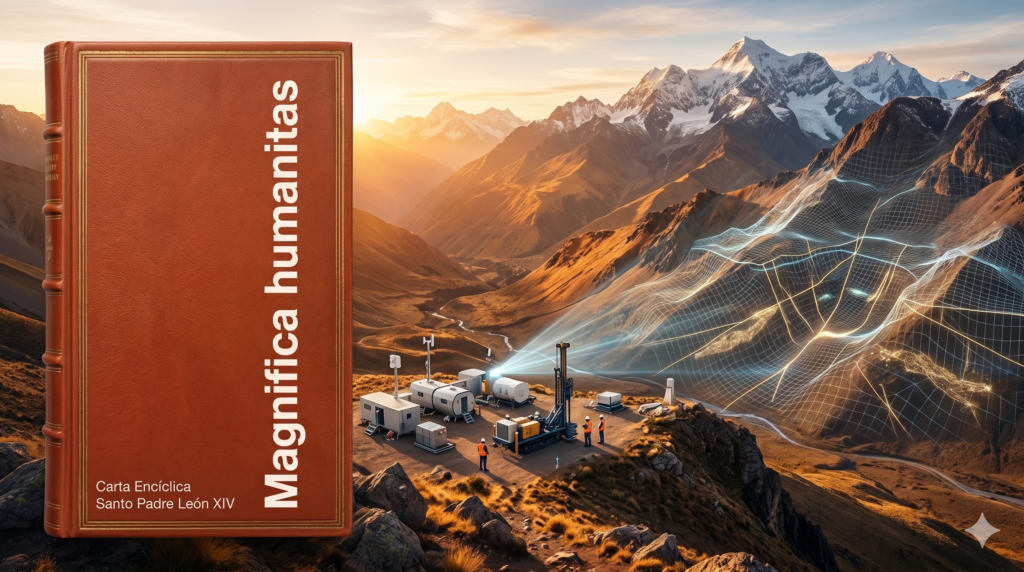
The recent publication of the encyclical Magnifica Humanitas by Pope Leo XIV marks a historic milestone in the teaching of the Church. Issued to mark 135 years since the landmark Rerum Novarum — the document with which Leo XIII addressed the impact of the Industrial Revolution — this new papal letter delves for the first time into the ethical and social dilemmas of Artificial Intelligence (AI). Yet beyond creeds or spiritualities, the text stands today as a universal invitation to reflection, one that calls on believers and non-believers alike. It is not a rejection of innovation, but an urgent call to safeguard the dignity of people and to ensure that technological systems always operate in service of human beings, and never at their expense.
The digital revolution is advancing at a pace that amazes us and, at the same time, produces an understandable sense of vertigo. On the global stage, that vertigo translates into constant pressure “not to be left behind.” Many workers today feel the unease of becoming just one more metric, or of having to adapt their lives to the relentless rhythm of an automated system. Behind that are real people facing uncertainty about their working future and their families’ livelihood.
From where we stand at Mineral Forecast, more than a decade immersed in the industry of AI applied to geosciences has taught us that the success of an algorithm is not measured in lines of code, but in the real value it brings to people. In a sector as strategic and historic as mining and exploration, advanced analytics is a formidable tool that reaffirms one conviction: empathy and ethical responsibility must always be our shared compass.
This balance is precisely the core of the recent ecclesiastical reflection. What millions of workers already feel day to day, the papal encyclical names with clarity in Chapter IV, Paragraph 150:
“…while AI promises to boost productivity by taking over ordinary tasks, workers are often forced to adapt to the speed and demands of machines, rather than having those machines designed to help those who work. Thus, contrary to the announced benefits of AI, current approaches to the technology may paradoxically de-skill workers, subject them to automated surveillance, and relegate them to rigid and repetitive tasks.”
In the field of geosciences, this premise takes on vital meaning. In developing predictive models for exploration and geology, our purpose has never been to replace the intuition, the years in the field, or the scientific judgment of professionals. On the contrary: we seek to empower the geologist and the exploration teams, freeing them from the repetitive burden of processing and integrating scattered, complex data. By optimizing those mechanical tasks, we give them back the time for what truly matters: interpreting the earth, making strategic decisions, and leading with the wisdom that only human experience possesses. AI finds hidden patterns in the data, but it is the geologist’s judgment that discovers and characterizes the deposit.
The real challenge is to advance alongside technology, keeping people at the center, and not to surrender to a blind automation that leaves us behind as a society. We are convinced that the former will prevail — but that will depend on how we, as an industry, collectively take on this responsibility.